The Shed Ceiling: How Much Hashrate the Breaker Will Actually Carry
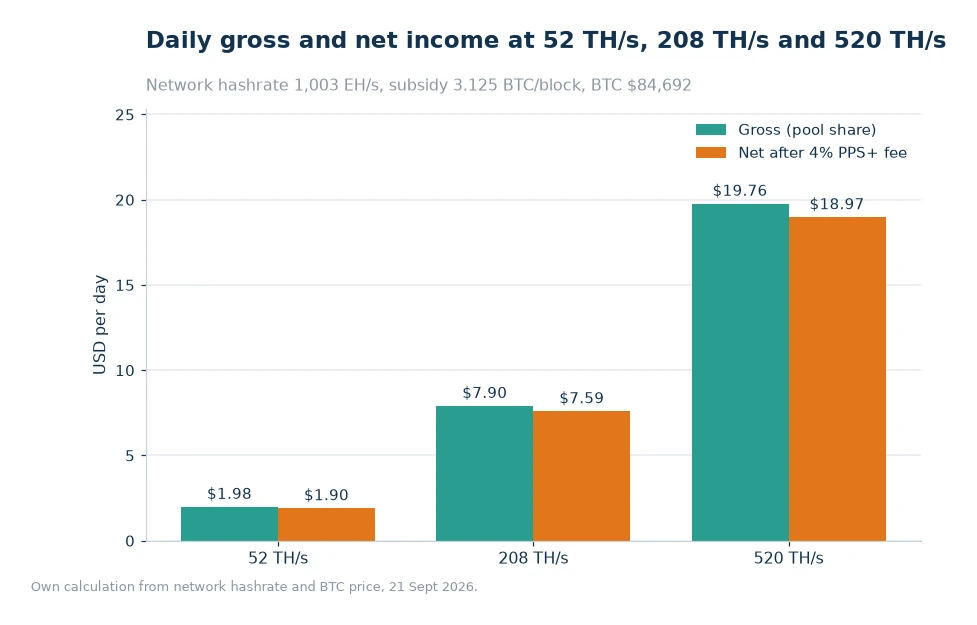
A garden shed is a fine place to mine until the breaker trips at dinner time. The ceiling is set by amperes, not ambition: a 30 A feed at 240 V will carry roughly 230 TH/s of modern hardware, less than half of the 520 TH/s tier. At 52 TH/s a shed sized install earns 0.00002333 BTC a day, $1.98 gross and $1.90 net after the listed 4%.
Key takeaways
- 52 TH/s returns 0.00002333 BTC a day, or $1.98 gross and $1.90 net at the listed 4%.
- 208 TH/s is four times the hashrate and 520 TH/s is ten times it, so the wiring scales in the same steps.
- Size the circuit at 80% of its breaker rating for continuous load; a 30 A feed is 24 A of miner, not 30.
- Leave one spare way in the panel for the fan, the light and the dehumidifier.
Start with the panel, not the price list
Every shed conversation should begin at the consumer unit. What is the main breaker, how many spare ways are free, and what cable runs from the house? Those three answers remove more options than any budget ever will. A shed with a 16 A radial circuit is a 50 TH/s shed. A shed with a 60 A submain is a different project entirely.
The miners themselves are simple loads: resistive, continuous, and unforgiving about voltage drop. That last point matters over a long cable run. A 30 m run at 20 A can lose enough voltage to make a power supply work harder and run hotter, which shortens its life. An electrician will size the cable for the load and the distance; a buyer who only sizes for the load will discover the rest later.
Three tiers and the feeds they need
The table assumes 25 J/TH, a reasonable figure for current air-cooled machines and an assumption rather than a specification. It also assumes a 240 V supply and a continuous-load factor of 80%, which is the usual derating for a circuit that runs for hours.
| Hashrate | Continuous draw | Current at 240 V | Minimum circuit | Net USD per day |
|---|---|---|---|---|
| 52 TH/s | 1.30 kW | 5.4 A | 10 A | $1.90 |
| 208 TH/s | 5.20 kW | 21.7 A | 30 A | $7.59 |
| 520 TH/s | 13.00 kW | 54.2 A | 63 A | $18.97 |
The jump from 208 to 520 TH/s is where most sheds stop. Fifty-four amps of continuous load needs a submain, a proper earth, and probably a conversation with the distribution network operator if the house supply is already loaded. None of that is impossible. It is simply a different budget from the one that bought the machines.
Continuous load is not breaker rating
A 30 A breaker does not promise 30 A forever. Continuous loads are derated because breakers and cables heat up, and a circuit run at its rating for weeks will eventually nuisance-trip or, worse, cook a terminal. The common practice is to design for 80%, so a 30 A circuit carries 24 A and a 63 A circuit carries about 50 A.
Apply that to the table and the 520 TH/s tier no longer fits a 63 A feed at 54.2 A. It needs the next size up, or a second feed. This is exactly the kind of detail that turns a plan into two electrician visits, and it is cheaper to learn from a table than from a melted plug.
The shed's own overhead
Miners are not the only load in a shed. An extractor fan moving 1,000 cubic metres an hour might draw 200 W. Lighting adds 50 W. A dehumidifier in a damp climate can cycle at 300 W. None of these is large alone; together they are a third of a kilowatt that never appears in a hashrate calculation.
There is also the question of what happens when the fan stops. A sealed shed with 13 kW of miners inside will reach temperatures that trigger thermal throttling within minutes, and the machines will protect themselves by reducing hashrate. The pool then credits less, and the operator sees a mystery dip. A thermostat-linked alarm on the exhaust is a cheap way to turn a silent failure into a phone notification.
What 52 TH/s teaches before 520 arrives
The smallest tier is the one that reveals the shed's real behaviour. Run it through a full week and watch three things: the temperature at the exhaust, the voltage at the socket under load, and the effective hashrate reported by the pool. Those three readings tell you more about whether the building can host 520 TH/s than any specification sheet.
They also give you a baseline for cost. At $0.07 per kWh, 1.3 kW costs $2.18 a day, which is more than the $1.90 net credit. A shed on a domestic tariff is rarely a profitable site at this scale; it is a place to learn and to use power you already pay for. Knowing that before you buy the bigger machines is worth the price of the small one.
Running the numbers for a quote
When a seller quotes a hashrate, convert it to amperes before anything else. The ViaBTC Mining Calculator gives the daily dollars; the joule rating on the machine's label gives the amps. Run the same figure through the Profit Calculator with your tariff to see whether the shed clears its own power bill. A quote that cannot be wired into the shed is not a cheaper option, it is a different project.
It is also worth checking what hosting would cost for the same hashrate. The Mining Farms listings show what a hosted slot looks like, and comparing that fee with the cost of a submain plus the shed's cooling is often the moment a domestic build stops making sense.
Worked example
Take 208 TH/s, the middle tier, and follow it from the network to the wire. Network share: 208 ÷ 1,003,000,000 = 0.0000002074. Times 450 BTC a day gives 0.00009332 BTC. At $84,692 that is $7.90 gross, and after the 4% PPS+ charge on the block reward it is $7.59 net.
Power side: 208 × 25 J = 5,200 W, which is 5.2 kW. At 240 V the current is 5,200 ÷ 240 = 21.7 A. Add the 80% rule and the circuit must be rated at 21.7 ÷ 0.8 = 27.1 A, so the next standard size is 30 A. The 10 A circuit already in the shed will not do it, and no amount of software will change that.
Check the scale against the smallest tier: 52 TH/s is one quarter of 208, so 0.00009332 ÷ 4 = 0.00002333 BTC and $7.59 ÷ 4 = $1.90. The largest tier is 2.5 times 208: 0.00009332 × 2.5 = 0.00023330 BTC, and $7.59 × 2.5 = $18.98, which rounds to the $18.97 in the chart. Its current is 21.7 × 2.5 = 54.3 A, just over the working limit of a 63 A breaker.
Frequently asked questions
Can I run 520 TH/s from a domestic supply?
It needs about 54 A of continuous current at 240 V, which is beyond a standard single-phase domestic feed after derating. Plan on a submain, a three-phase supply, or a smaller hashrate.
How many amps does 52 TH/s draw?
At 25 J/TH it draws 1.3 kW, which is 5.4 A at 240 V. A 10 A circuit has enough headroom for that plus a fan, but little else.
Do I need to derate the breaker for continuous mining?
Yes. Design for about 80% of the breaker rating so the circuit is not sitting at its limit for weeks; that turns a 30 A feed into 24 A of usable mining load.
Wire for the tier above the one you buy
Cable is cheap compared with a second visit from an electrician. If the plan might reach 208 TH/s in two years, run the submain for that now and start with the 52 TH/s machine. The pool state page will tell you what the network is doing in the meantime, so the decision to expand can rest on difficulty and price rather than on a guess.
Then buy machines to fit the wire, not wire to fit the machines. The shed only has one ceiling, and it is measured in amperes.
Sources: ViaBTC calculator, farms and pool pages[1]. Figures read 21 Sept 2026: difficulty 132.76 T; network 1,003 EH/s; 3.125 BTC per block; 144 blocks a day; BTC $84,692. Published 24 Oct 2026. The 25 J/TH figure, 240 V supply and 80% derating are assumptions.